Java NIO2 - Watching a directory for changes. FileWatcherService.
File Watch Service
The NIO2 WatchService API provides the ability for java code to
watch for file modifications in a directory in the filesystem. A WatchService
object watches the folder it is registered with and signals the changes
detected through event notifications.
Steps to create a WatchService
- Create a WatchService object (FileSystem.newWatchService())
- Register the directories to be watched with the WatchService (WatchService.register())
- Watch for file change events (poll()/take() methods)
- Retrieve the event keys and process them
- Rest the key and got to step 3 to watch again.
Example code
Below is a simple working code.
import java.io.IOException;
import java.nio.file.Path;
import java.nio.file.Paths;
import java.nio.file.StandardWatchEventKinds;
import java.nio.file.WatchEvent;
import java.nio.file.WatchKey;
import java.nio.file.WatchService;
import java.util.List;
import java.util.concurrent.TimeUnit;

public class FileWatcherTest {

 private static void watchDir(Path dirPath) throws IOException, InterruptedException{

  WatchService watchService = dirPath.getFileSystem().newWatchService();
  dirPath.register(watchService, StandardWatchEventKinds.ENTRY_CREATE,StandardWatchEventKinds.ENTRY_DELETE,StandardWatchEventKinds.ENTRY_MODIFY);
  for(;;){
   WatchKey key = watchService.take();
   //WatchKey key = watchService.poll(25,TimeUnit.SECONDS);
   System.out.println("watch at :" + new java.util.Date() + " - key :" + key);
   if(key == null) continue;
   List<watchevent> events = key.pollEvents();
   for(WatchEvent event : events){
    System.out.println("Event :" + event.kind() + " " + event.context().toString());
   }
   if(!key.reset()){
    System.out.println("Breaking ...");
    break;
   }
  }
 }

 public static void main(String[] args) throws IOException, InterruptedException {

  Path path =  Paths.get("C:\\watchtest");
  watchDir(path);

 }

}
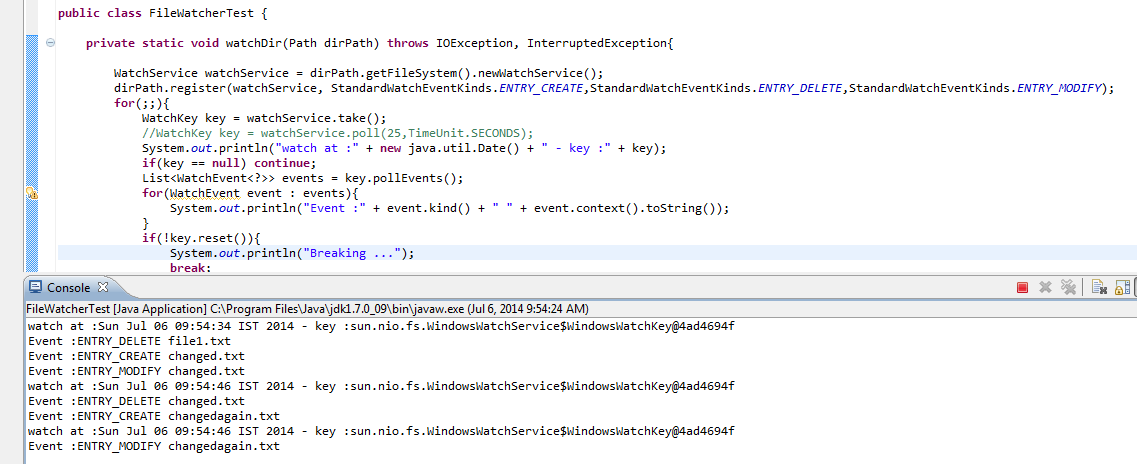
A sample run gives following output.
Thanks for providing such great and useful informations on your blog.update more data later.
ReplyDeleteHadoop Training in Chennai
Big data training in chennai
Big Data Hadoop Training in Chennai
JAVA Training in Chennai
Python Training in Chennai
IOS Training in Chennai
hadoop training in Annanagar
big data training in chennai anna nagar
Big data training in annanagar
Thanks for the informative article. This is one of the best resources I have found in quite some time.
ReplyDeleteSpoken English Classes in Chennai
Best Spoken English Classes in Chennai
German Classes in Chennai
IELTS Coaching in Chennai
spanish classes in chennai
French Classes in Chennai
TOEFL Coaching in Chennai
Spoken English Classes in Velachery
Spoken English Classes in Tambaram
Spoken English Classes in Anna Nagar
it was a great informative blog. thanks for it
ReplyDeletepython courses in Bellandur|python courses in Marathahalli
selenium testing courses in kalya Nagar|selenium courses in Marathahalli
devops courses in Bellandur|devops courses in Marathahalli
python courses in bangalore|python training in bangalore
ReplyDeleteI went through your blog its really interesting and holds an informative content. Thanks for uploading such a wonderful blog.
python courses in Bellandur|python courses in Marathahalli
selenium testing courses in kalya Nagar|selenium courses in Marathahalli
devops courses in Bellandur|devops courses in Marathahalli
python courses in bangalore|python training in bangalore
Its an interesting blog with informative content. Thanks for this blog
ReplyDeletepython courses in Bellandur|python courses in Marathahalli
selenium testing courses in kalya Nagar|selenium courses in Marathahalli
devops courses in Bellandur|devops courses in Marathahalli
python courses in bangalore|python training in bangalore
python courses in bangalore
I have been searching for this information and got to know now. Thanks to the admin for sharing this blog.
ReplyDeleteEnglish Speaking Classes in Mulund
IELTS Classes in Mulund
German Classes in Mulund
French Classes in Mulund
Spoken English Classes in Chennai
IELTS Coaching in Chennai
English Speaking Classes in Mumbai
IELTS Classes in Mumbai
Spoken English Class in Anna Nagar
IELTS Coaching in Tambaram
Good blog!!! It is more impressive... thanks for sharing with us...
ReplyDeleteSelenium Training in Chennai
Best selenium Training Institute in Chennai
selenium testing course in chennai
Selenium Course in Chennai
Selenium training in Thiruvanmiyur
Selenium Training in Velachery
Python Training in Chennai
Software testing training in chennai
Python Training in Chennai
JAVA Training in Chennai
This comment has been removed by the author.
ReplyDeleteYour post is just outstanding! thanx for such a post,its really going great and great work.
ReplyDeleteaws Training in Bangalore
python Training in Bangalore
hadoop Training in Bangalore
angular js Training in Bangalore
bigdata analytics Training in Bangalore
Lovely blog ..! I really enjoyed reading this article. Thank you for sharing such a wonderful post
ReplyDeleteaws Training in Bangalore
python Training in Bangalore
hadoop Training in Bangalore
angular js Training in Bangalore
bigdata analytics Training in Bangalore
Nice blog..! I really loved reading through this article. Thanks for sharing such a amazing post with us and keep blogging...Well written article
ReplyDeleteaws Training in Bangalore
python Training in Bangalore
hadoop Training in Bangalore
angular js Training in Bangalore
bigdata analytics Training in Bangalore
I have to agree with everything in this post. Thanks for useful sharing information.
ReplyDeleteHadoop Training in Chennai
Hadoop Training in Bangalore
Big Data Course in Coimbatore
Big data course in bangalore
Big Data Course in Chennai
Big Data Training in Bangalore
Python Training in Bangalore
Python Training in Coimbatore
astrologers in india
ReplyDeleteastrology online
best astrologer in andhra pradesh
best astrology online
astrology
famous astrologer in andhra pradesh
best astrologer near me
top 10 astrologers in andhra pradesh
ReplyDeleteThis Blog have relevant information’s and reference links which not get bored to the readers.
Ethical Hacking Course in Chennai
Ethical Hacking course in Bangalore
THANK YOU for this amazing and for sharing this blog with us, it is very helpful.
ReplyDeleteplease keep updated us more about like this type of blog.
If someone is looking for the best java training institute for software training in Ghaziabad, java training institute
It is the best place from where you get the practical knowledge of java training institute here. You will be an expert in this field after doing the java training.
incredibly insightful and fascinating one. Comprehending the most recent developments in software testing is quite beneficial. really beneficial for those wishing to launch their careers CA Coaching in Hyderabad
ReplyDeleteOh my! Good blog. I perused your blog. For both me and others, it is really beneficial. I'd want to read more books. Click this to see my website as well. Top CA Coaching Institute in Hyderabad
ReplyDelete907D1FEEA3
ReplyDeletehacker kirala
hacker bulma
tütün dünyası
hacker bul
hacker kirala
6DFE9513B5
ReplyDeleteBeğeni Satın Al
Mobil Ödeme Takipçi
Takipçi Fiyatları